Decision frame
What must be true for the project to work—and what would kill it.
01 · FEASIBILITY STUDY
A decision document for developments that need more than demographic rings, broker optimism, or a spreadsheet built to say yes.
Book a scope call
WHAT THIS IS
The study assembles demand, supply, site conditions, ownership, pipeline, rents, costs, and competitive behavior around one decision. The conclusion can be yes, no, or yes—but not this version.
INSIDE THE STUDY
What must be true for the project to work—and what would kill it.
Trade area, households, employment, spending, growth, and demand drivers.
Existing inventory, pipeline, absorption, rents, vacancy, and positioning.
Access, visibility, adjacency, parcel context, ownership, and constraints.
Base case, downside case, sensitivity, and the assumptions doing the work.
The facts that could change the conclusion and how to monitor them.
Proceed, revise, pause, or walk—with a defensible reason attached.
A REAL EXAMPLE
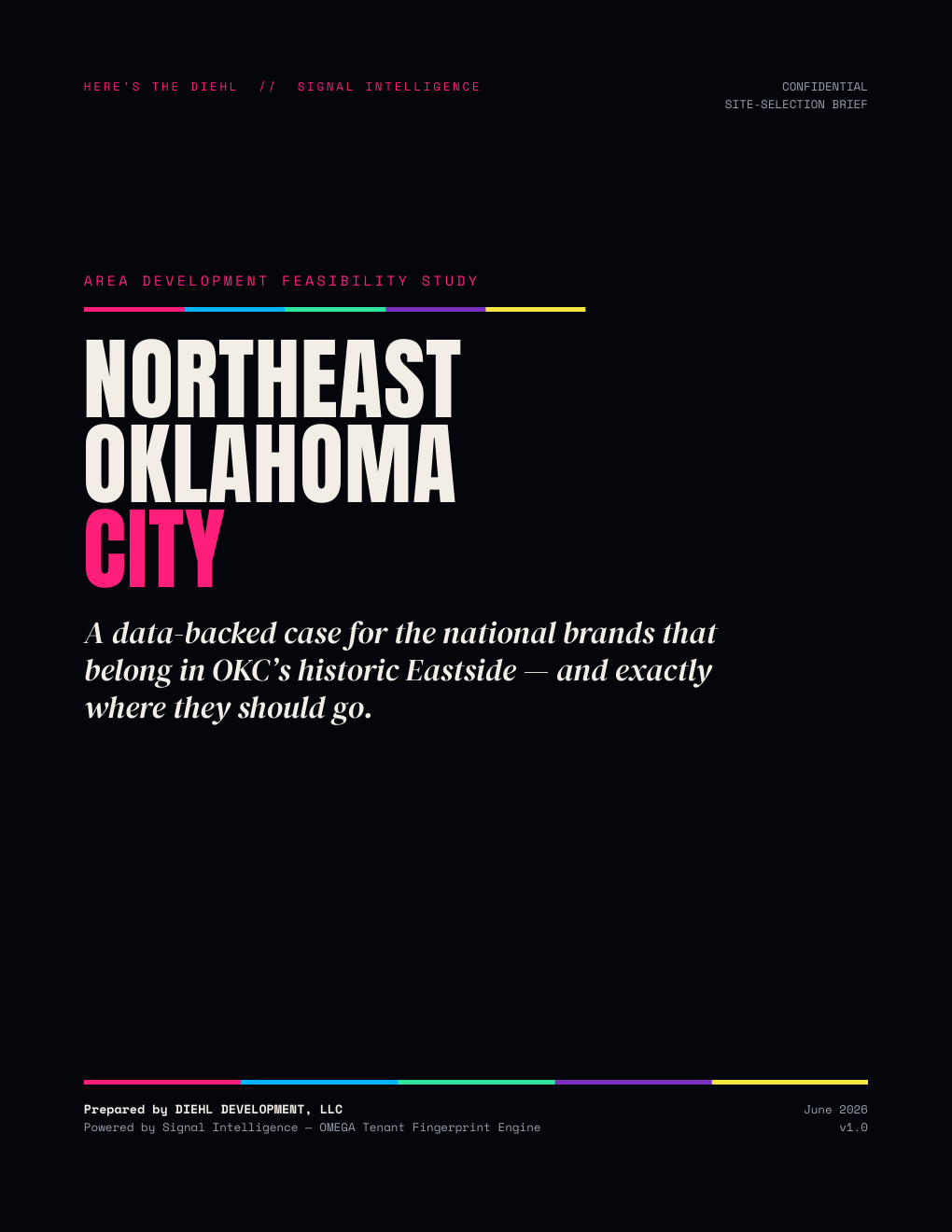
A corridor-level demand case translated into brand fit, competitive gaps, development patterns, and ranked sites. The point was not to describe northeast Oklahoma City. It was to decide what belonged there next.
BEST FIT
Ground-up development
Adaptive reuse
Public-private projects
Capital partner diligence
Go / no-go decisions
START WITH THE DECISION